Thesis Statement Generator: Free AI Tool + 25 Examples for Academic Essays

What Is a Thesis Statement and Why Is It So Important?
When you write English essays, one of the comments you are most likely to see is: “Your thesis statement isn’t clear enough.” The thesis statement usually appears in the last 1–2 sentences of the introduction. It is the central claim of your paper and, in concise language, tells the reader: what you are talking about (topic), what position you take (stance), and how you will argue for it (reasons/approach).
In shorter course assignments, the thesis is often one relatively compact sentence. In longer research papers or theses, it may become two or three sentences or even a short paragraph, but its core function does not change: to present a clear, debatable central idea, rather than simply repeating the prompt or background information.
Readers use your thesis statement to judge whether each paragraph that follows stays focused on the central argument or drifts into repetition and filler. Instructors also use it to quickly see whether your paper is actually “answering the question” instead of just “introducing the topic.”
From the perspective of the writing process, a thesis statement has three main roles:
- For you as the writer: it helps you focus, so you know what should be included and what can be cut.
- For the reader: it sets expectations in advance, so they know why they are reading and what they will see.
- For the grader: it is usually the direct basis for rubric items such as “central argument” and “clarity of thesis.”
Different types of essays place slightly different emphasis on the thesis:
- Argumentative essay: presents an arguable claim and hints at the main reasons that support that position.
- Expository / explanatory essay: summarizes what you will explain and from which key angles you will break it down.
- Analytical / literature essay: offers your interpretation of texts, data, or phenomena, rather than just retelling plot or listing facts.
In practice, many students run into three common problems:
- Too broad: the thesis just repeats the topic, for example, “Social media is important in modern society.” There is no clear stance or scope.
- Too descriptive: it merely announces the essay, such as “This essay will discuss the causes of climate change,” without revealing your own view.
- Too vague: it relies on empty words (significant, important, very, many factors) without explaining why or how something matters.
A strong thesis statement usually does three things at once:
- Clearly narrows the scope (to a specific group, time, or context) instead of staying vague and general.
- States a clear stance (supporting, opposing, comparing, or explaining a particular claim) rather than just describing facts.
- Hints at structure by pointing to at least two or three key reasons or lines of analysis, so readers can anticipate how the essay will be organized.
In the rest of this guide, we will first use an AI tool to draft thesis ideas quickly, then use discipline-specific examples and simple templates to help you apply these techniques to your own writing.
Using an AI Tool to Draft Your Thesis (Workflow Example)
An AI tool cannot “think” for you, but it is very good at turning ideas you already have into one or two clear, logical thesis statements. Most academic writing tools that support outline and thesis generation follow a similar overall approach.
Workflow Example
- Enter the prompt and assignment requirements
Copy the topic, word count range, required number of sources, and any additional instructions from your instructor. In the AI writing tool you use, choose the appropriate subject and assignment type (such as argumentative essay or research paper), and add any emphasis or constraints you want the tool to consider.

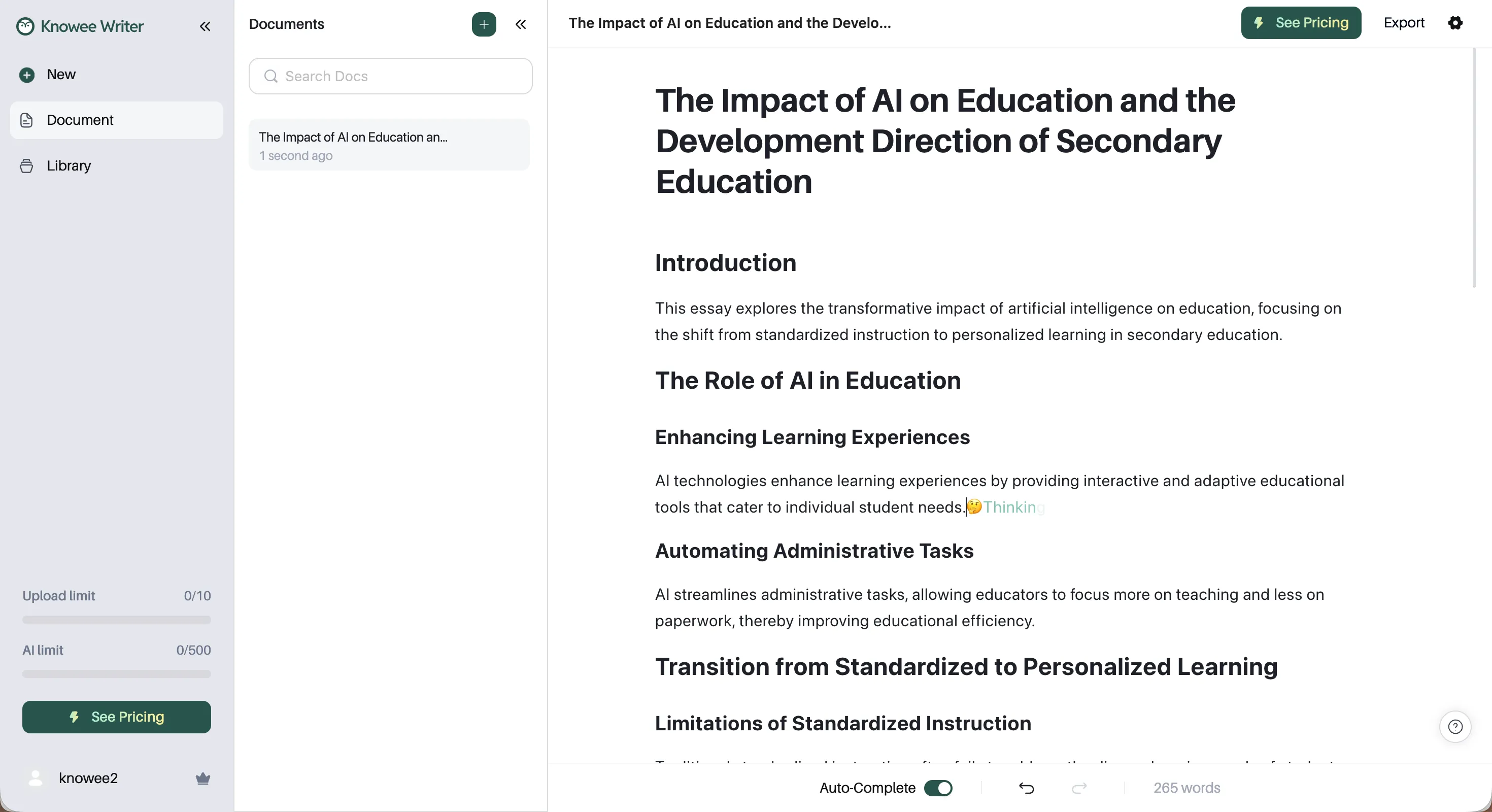
- Generate an outline and key sentences with one click
In the editor, click to generate content. The tool will typically produce:- a thesis statement;
- a full outline broken down by paragraph;
- a topic sentence or key claim for each body paragraph.
- Quickly adjust the structure and direction of your argument
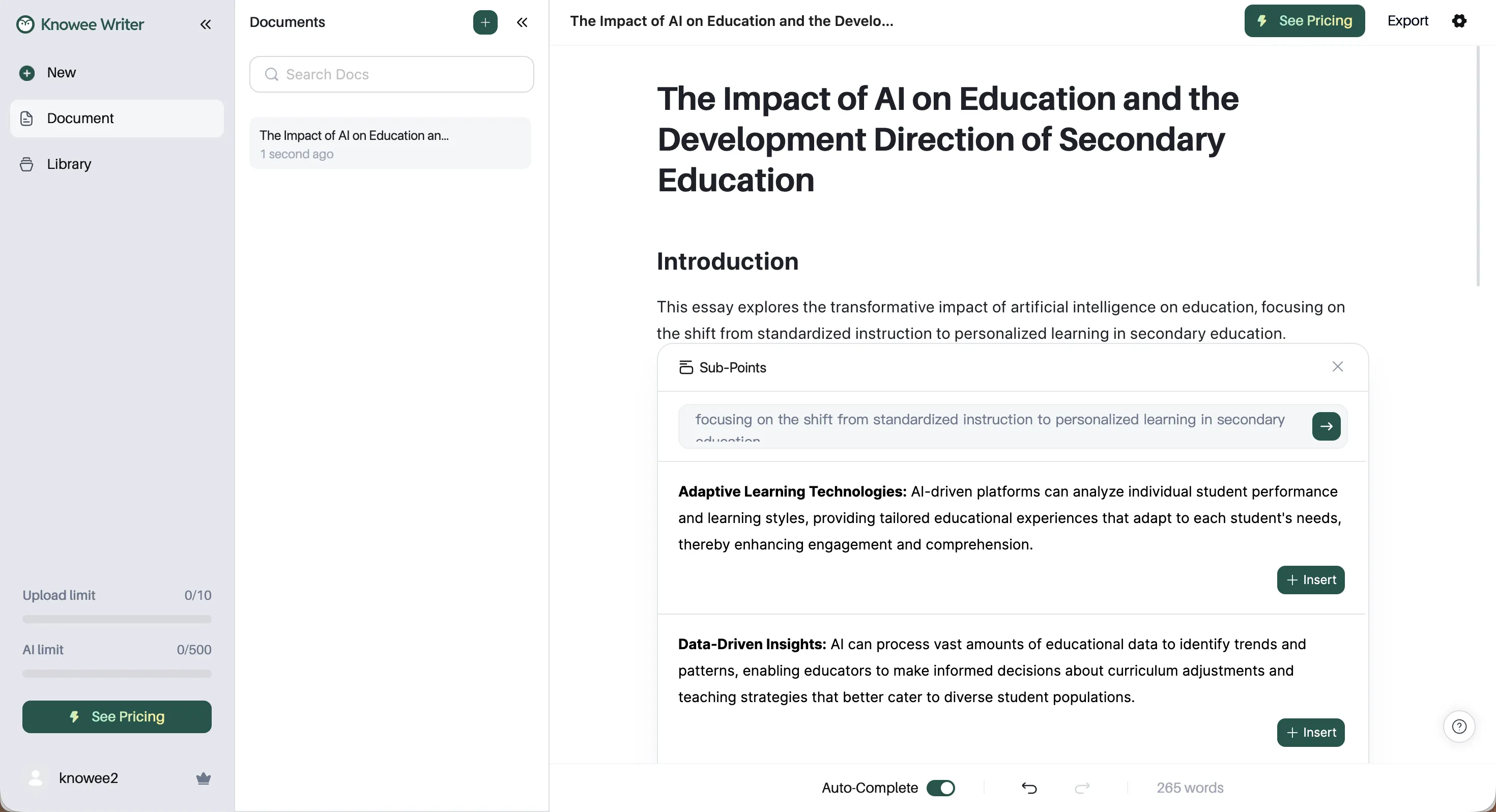
Read through the generated outline. Delete points that are not relevant, merge repeated ideas, or rewrite sentences that sound too absolute or emotional so they better fit classroom expectations. You can also break a very broad main claim into multiple sub-claims: select the related sentences and use a “generate subpoints” function to produce subpoints (sub-claims plus explanations) based on the main thesis.
- Highlight specific parts and let AI refine or expand them
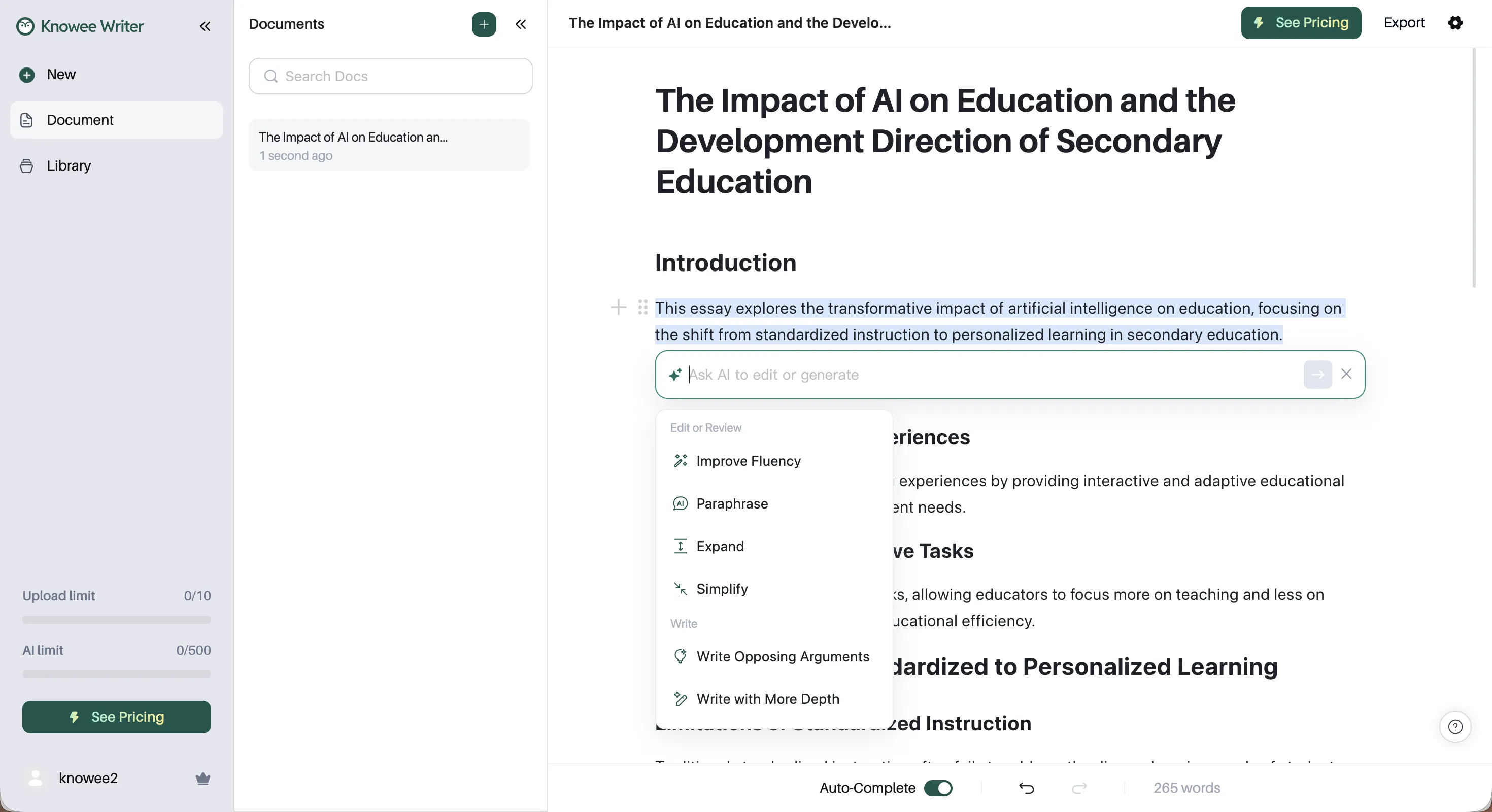
If a sentence does not sound natural, highlight it and use a “rewrite/improve” feature to make the logic clearer and the tone more academic. If you feel that a paragraph’s reasoning is still too thin, you can highlight the relevant section and ask the tool to expand it with additional reasons or examples.
Tools like Knowee Writer, which are designed specifically for academic writing, integrate these steps—entering requirements → one-click outline and key sentences → selecting parts to refine or expand—into a single interface. That way, you can focus most of your attention on evaluating and polishing the key sentences themselves, instead of constantly copying and pasting or switching between multiple windows.
How to Maintain Academic Integrity When Using AI
Even if you use a thesis statement generator, it is still a good idea to:
- Treat the generated results as a draft, not the final version you submit.
- Check for yourself whether the thesis matches the assignment, readings, and what was covered in class.
- Follow your instructor’s or university’s AI policies, and clearly indicate the tool’s assisting role if required.
AI can help you move past the “I have no idea what to say” stage more quickly, but real critical thinking still comes from your own judgment.
25 Thesis Statement Examples (By Discipline)
The examples below assume you are writing in English, so the thesis statements themselves are in English, followed by a brief explanation of their strengths and suggested use cases in Chinese. You can take the structure, sentence patterns, and angles and adapt them to your own essay topics.
Literature
-
In “The Great Gatsby”, F. Scott Fitzgerald uses the recurring motif of the green light to expose the emptiness of the American Dream, suggesting that the pursuit of wealth inevitably leads to moral disillusionment.
Why it works: It clearly identifies the work, the key motif (the green light), and the theme (the emptiness of the American Dream), and explains what this device reveals.
Best for: Literary analysis essays on The Great Gatsby, symbolism, or the American Dream. -
By portraying Elizabeth Bennet’s evolving perception of Mr. Darcy, “Pride and Prejudice” critiques the limitations of class prejudice and argues that genuine understanding requires challenging inherited social judgments.
Why it works: It shows how character development is used to criticize class prejudice and ties plot changes directly to the thematic claim.
Best for: Essays on character, narrative, and social class in Pride and Prejudice. -
In “1984”, George Orwell demonstrates how language manipulation functions as the Party’s most powerful tool of control, revealing that the erosion of truthful language leads directly to the erosion of independent thought.
Why it works: It focuses on one core device (language manipulation) and emphasizes the causal link between language and thought.
Best for: Essays on ideology, language, and power in dystopian literature. -
Through the imagery of blood and darkness in “Macbeth”, Shakespeare traces the psychological consequences of unchecked ambition, arguing that guilt remains inescapable even after power is secured.
Why it works: It connects concrete imagery (blood and darkness) with abstract themes (ambition and guilt), making it easy to organize body paragraphs around specific images.
Best for: Shakespeare essays on tragic psychology or symbolic imagery. -
By contrasting Jane Eyre’s moral independence with Rochester’s moral compromise, Charlotte Brontë suggests that personal integrity is ultimately more valuable than social status in Victorian society.
Why it works: It uses character contrast to make a debatable claim (integrity vs. status), which naturally supports a comparative structure.
Best for: Essays on character comparison, women’s agency, and class norms in Victorian fiction. -
Through its fragmented structure and shifting voices, T. S. Eliot’s “The Waste Land” embodies the spiritual disillusionment of post–World War I Europe, suggesting that modern life is defined by cultural and emotional fragmentation.
Why it works: It tightly links formal features (fragmented structure, multiple voices) with historical context and theme.
Best for: Modernist poetry essays that connect form and meaning.
History
-
The Industrial Revolution transformed European society not simply by introducing new machines but by fundamentally redefining labor relations, leading to new forms of class conflict and urban identity.
Why it works: It moves beyond a generic “technology changed everything” statement and focuses on labor relations and class, which are rich for social-historical analysis.
Best for: Essays on modern European history, labor history, or industrialization. -
Meiji Japan’s rapid modernization succeeded because leaders selectively adopted Western institutions while preserving imperial authority, demonstrating how cultural continuity can coexist with radical economic change.
Why it works: It presents a clear causal chain—selective borrowing plus preserved imperial authority → successful modernization—and invites comparison with other countries.
Best for: East Asian history or comparative modernization essays. -
The success of the U.S. civil rights movement in the 1950s and 1960s depended less on charismatic national leaders than on grassroots organizing, showing that local activism was the engine of national legislative change.
Why it works: It challenges a “great leaders” narrative and shifts focus to local organizing, which adds analytical depth.
Best for: U.S. history or social movement essays emphasizing bottom-up change. -
The doctrine of mutually assured destruction during the Cold War paradoxically promoted stability, as the fear of nuclear annihilation constrained both U.S. and Soviet foreign policy decisions.
Why it works: It uses “paradoxically” to highlight a counterintuitive claim and sets up body paragraphs built around specific policy examples.
Best for: Cold War history or international relations essays on deterrence and nuclear strategy. -
China’s one-child policy not only curbed population growth but also reshaped family structures and gender expectations, producing long-term demographic and social challenges that outweigh its short-term economic benefits.
Why it works: It goes beyond population control to include family and gender, allowing multi-angle analysis.
Best for: East Asian social history, population policy, or demographic change essays. -
Post–World War II decolonization in Africa was driven as much by shifting international norms of self-determination as by local nationalist movements, revealing the intertwined nature of global and local forces in political change.
Why it works: It places international norms and local nationalism in the same frame, emphasizing multiple causes rather than a single-factor explanation.
Best for: African history, international relations, or decolonization essays.
Social Sciences
-
While social media connects adolescents across the globe, it ultimately harms their mental health by normalizing constant social comparison and disrupting healthy sleep patterns.
Why it works: The “while… ultimately…” structure acknowledges benefits but clearly states a negative overall conclusion.
Best for: Psychology, education, or communication essays on social media and youth mental health. -
The gig economy increases short-term flexibility for workers but reinforces economic insecurity by shifting risks from employers to individuals without providing adequate social protections.
Why it works: It clearly lays out pros and cons and provides a causal logic (risk shifting + weak protections → insecurity).
Best for: Sociology, labor economics, or public policy papers. -
Second-generation immigrants construct hybrid identities that challenge traditional notions of national belonging, illustrating how migration reshapes both host and origin cultures.
Why it works: It avoids portraying immigrants as passive adapters and instead emphasizes their active role in reshaping identities and cultures.
Best for: Migration studies, cultural studies, or social psychology essays. -
Standardized testing in public schools reproduces existing social inequalities because it rewards prior access to resources rather than measuring students’ true learning potential.
Why it works: It clearly links standardized tests to inequality and argues that tests reward resource advantages instead of “merit.”
Best for: Education, social inequality, or education policy analysis. -
Media portrayals that associate caregiving primarily with women reinforce gender inequality by shaping children’s expectations about appropriate careers and family roles.
Why it works: It approaches gender inequality through media representation and focuses on how expectations are formed.
Best for: Gender studies, media studies, or developmental psychology essays. -
Life in global megacities increases feelings of loneliness despite higher population density because it weakens long-term community ties and prioritizes efficiency over meaningful social interaction.
Why it works: It identifies a counterintuitive phenomenon (“more people, more loneliness”) and explains it with two structural factors.
Best for: Urban sociology, social psychology, or essays on contemporary city life. -
The shift to remote work after the COVID-19 pandemic has permanently blurred the boundary between home and workplace, transforming norms of productivity, surveillance, and employee autonomy.
Why it works: It takes the blurred boundary as a starting point and specifies three areas of change, which can easily become separate body sections.
Best for: Organizational behavior, HR management, or digital work essays.
Science / STEM
-
Human-driven climate change is the primary driver of the increasing frequency of extreme weather events, as rising greenhouse gas emissions intensify heatwaves, storms, and droughts worldwide.
Why it works: It states a clear position (human-driven, primary driver) and lists concrete consequences, which supports a scientific discussion.
Best for: Environmental science, geography, or policy-oriented essays on climate. -
High vaccination coverage is essential for protecting vulnerable populations because herd immunity prevents outbreaks even among individuals who cannot be vaccinated.
Why it works: It uses “because” to directly present the mechanism (herd immunity) and invites support from data and graphs.
Best for: Public health, epidemiology, or health policy essays. -
Transitioning to renewable energy is not merely a technical challenge but a political one, requiring policy incentives that shift investments away from fossil fuels toward sustainable infrastructure.
Why it works: It widens the frame from “technical problem” to “political and policy problem,” which better fits interdisciplinary assignments.
Best for: Environmental policy, energy politics, or sustainable development essays. -
Integrating artificial intelligence into medical diagnosis can improve accuracy and efficiency only if algorithms are trained on diverse datasets that prevent the amplification of existing health disparities.
Why it works: Instead of simply praising AI, it adds a condition (diverse datasets) and raises fairness concerns.
Best for: Health informatics, science and technology studies (STS), or public health ethics courses. -
Single-use plastics contribute disproportionately to marine pollution, and reducing them at the source is more effective than relying solely on downstream recycling initiatives.
Why it works: It states the problem and takes a clear policy stance (source reduction over end-of-pipe recycling).
Best for: Environmental science, public policy, or sustainability essays. -
Investing in space exploration accelerates technological innovation on Earth by driving advances in materials science, robotics, and communication systems that later diffuse into everyday applications.
Why it works: It argues for the indirect benefits of space exploration and lists three technology areas that can be developed in case studies.
Best for: Science policy, innovation studies, or argumentative science writing.
How to Write a Strong Thesis Without Any Tools: One Practical Method
Even if you do not want to use any AI tools for now, you can still write a clear and persuasive thesis statement by following a few simple steps.
The “Question → Position → Three Reasons” Method
You can think through your thesis in the following order:
- Write down the essay question given by your instructor.
- Answer that question in one sentence (your position).
- List two or three core reasons that support this position (your reasons or lines of analysis).
The first two steps give you a working thesis—a draft version that does not need to be perfect. After listing your reasons, go back and check whether this sentence:
- Answers the real “how/why” in the prompt, instead of simply rephrasing the question.
- Is specific about time, place, and audience, instead of relying on vague words like “many”, “a lot”, or “very important”.
- Makes a judgment that someone could disagree with, instead of repeating common-sense facts everyone accepts.
Then compress the “question + position + reasons” into one sentence, for example:
Although social media offers new opportunities for connection, it ultimately harms teenagers’ mental health because it encourages constant comparison, reduces sleep, and increases exposure to cyberbullying.
To make this easier, you can use a simple, downloadable thesis statement template that guides you through the process step by step: thesis statement template.
When It’s Worth Opening Knowee Writer
If you only write the occasional short essay, manually refining your thesis using the method above is usually enough. But when you need to:
- Write multiple essays across different subjects in one semester and want more practice and faster iterations;
- Repeatedly refine the core argument for a capstone project or long research paper;
- Generate thesis statements, outlines, reading directions, and continuation drafts in one place;
it can be helpful to treat Knowee Writer as a regular writing partner. You can first use the logical framework above to clarify your own stance, then let the tool generate several alternative thesis statements, choose the one you prefer, and revise it further. This way, you avoid relying completely on AI, but you also spend less time stuck on the first sentence.
The goal of this article, together with the 25 examples, is to help you write clearer, stronger, and more academically appropriate thesis statements for your next essay.